
Patient Insurance Verification: A Simple 3-Step Guide
In today’s healthcare environment, accurate and timely patient insurance verification is critical to reducing denial claims, improving cash flow, and providing a seamless patient experience. A thorough verification process can help healthcare providers prevent costly billing issues before treatment begins, from verifying active coverage to checking deductibles and requesting prior authorizations.
Whether you run a private practice, a specialty clinic, or a large healthcare organization, a team with expertise in insurance verification can significantly improve operational efficiency and reimbursement accuracy.
What is Patient Insurance Verification?
Patient insurance verification is the process of validating a patient’s insurance coverage, eligibility, benefits, and financial responsibility prior to the rendering of medical services.
This step helps providers:
- Check active insurance coverage
- Check co-pays, deductibles, and co-insurance
- Identify referral/authorization requirements
- Reduce claim denials and payment delays
- Improving patient billing transparency
A reliable process for verifying health insurance helps patients and providers understand the coverage details clearly before starting treatment.
Why Is Insurance Verification Important In Healthcare?
Failure or delay in patient insurance eligibility verification may result in:
- Claim denials
- Delayed reimbursements
- Increased administrative workload
- Unexpected patient bills
- Patient dissatisfaction
Correct insurance policy verification in healthcare helps medical practices stay financially stable and improve the patient experience.
How To Verify Insurance Coverage?

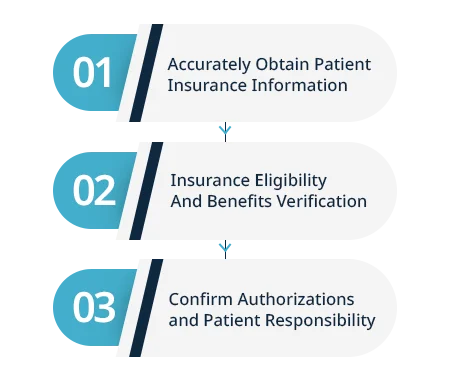
Step 1: Accurately Obtain Patient Insurance Information
The first step in the patient coverage verification process is to obtain complete and accurate information during scheduling or registration.
Some key information is
- Insurer’s name
- Policy number
- Group number
- Subscriber Information
- DOB
- Referral information
- Copies of photo ID and insurance card
Correct patient insurance information reduces errors later in the billing cycle.
Many providers are now integrating patient registration and insurance verification into front desk workflows to speed up intake and minimize errors.
Step 2: Insurance Eligibility And Benefits Verification
Once patient details are gathered, staff can start verifying patient insurance eligibility.
It includes:
- Active insurance status
- Verify services covered
- Check co-pays and deductibles
- Checking network participation
- Identifying visit limits
- Specialist referral requirements confirmation
This process is also called insurance benefits verification or patient eligibility and benefits verification.
Today’s healthcare organizations are turning to real-time insurance verification tools to automate those checks and cut down on manual work.
Step 3: Confirm Authorizations and Patient Responsibility
Finally, check if prior authorization is required before treatment. This step in the insurance prior authorization and verification process helps providers avoid denied claims for non-approved services.
Healthcare teams must:
- Check prior authorization requirements
- Keep records of approval numbers
- Verify patient financial responsibility
- Notify patients of estimated out-of-pocket costs
If done correctly, this step helps providers verify patient coverage before treatment and aids in improving billing transparency.
Automated Vs. Manual Insurance Verification
Many health care organizations are forced to weigh the use of manual eligibility verification methods against automated systems.
Manual Insurance Verification
Manual verification is usually done via phone calls to insurance providers or logging into payer portals one at a time.
Benefits
- Direct communication with the payer
- Good for complex coverage questions
Disadvantages
- Time-consuming.
- More vulnerable to human error
- Longer appointment processes
Automated Insurance Verification
Insurance verification is performed in real time via automated systems through clearinghouses or integrated software.
Benefits
- Expedited eligibility checks
- Cut down on administrative work
- Better precision
- Better efficiency in patient scheduling
- Faster reimbursement cycles
Disadvantages
- Initial investment in software
- Requires system integration
- Staff training
With healthcare practices scaling, automation is becoming increasingly important to efficiently verify patient eligibility and benefits and to drive long-term operational growth.
Best Practices To Accurately Verify Insurance
Below are some of the best practices for healthcare providers to improve their medical insurance verification workflow.
- Verify Coverage Before Each Visit
Policy changes can affect even returning patients - Regularly Train Front Desk Staff
An informed team helps to reduce verification errors - Automated Verification Systems
Automation increases accuracy and reduces delays. - Keep Detailed Documentation
Maintain proper documentation of eligibility checks and prior authorization approvals. - Communicate Financial Responsibility Clearly
When patients know the cost up front, it builds trust and helps us get paid.
Common Challenges in the Insurance Verification Process
Even experienced healthcare teams have verification challenges that can affect revenue cycle performance.
- Missing Patient Data
Missing policy details often delay the verification and the billing.
- Constant Insurance Changes
Patients can alter plans without updating records.
- Delays In Manual Verification
Manual verification can take a lot of administrative time.
- Authorization Error
Claims may be denied if prior authorization is not secured.
A well-optimized front desk insurance verification workflow can help minimize these challenges significantly.
How Technology Simplifies Insurance Verification
Today, medical providers use advanced digital solutions and clearinghouse platforms to simplify the process of verifying healthcare insurance.
They often implement or use;
- Insurance payer portals
- Electronic system for verification
- Clearinghouse software
- Patient cost estimator
- Integrated Eligibility Tools in EHRs
- Automated patient registration systems
These technologies help with:
- Automated eligibility checks
- Reduced staff workload
- Enhanced claim precision
- Accelerated reimbursements
Using reliable tools to verify patients’ insurance before the appointment improves operational efficiency and patient satisfaction.
The Impact of Insurance Verification on Revenue Cycle Management
A strong process for verifying patient insurance is a key part of the overall revenue cycle management (RCM) puzzle. Performing eligibility checks immediately before treatment can drastically reduce administrative issues that result in delayed or denied payments for healthcare providers.
Effective management of the insurance verification process helps:
- Decrease claim denials
- Increase clean claim submission rates
- Reduce payment delays
- Less administrative re-work
- Increase total collections
Many denied claims relate to inactive coverage, authorization issues, or wrong patient information. By implementing a detailed process for verifying patient coverage prior to appointments, providers can avoid these costly mistakes and maintain healthier cash flow.
Final Takeaway
One of the most critical steps in healthcare revenue cycle management is an effective patient insurance verification process. Healthcare organizations can reduce denials, improve collections, and improve the patient experience when they verify eligibility, benefits, and authorizations before treatment.
As insurance requirements evolve, providers can continue to operate efficiently, stay compliant, and remain financially stable by investing in streamlined verification workflows and automated eligibility tools.
Need a faster and more accurate way to manage patient insurance verification? Our expert solutions help healthcare providers streamline eligibility checks, reduce claim denials, and improve reimbursement workflows.
Frequently Asked Questions (FAQs)
Patient insurance verification is the process of verifying a patient’s active insurance coverage, eligibility, benefits, and authorization requirements before any medical services are rendered.
Correct insurance eligibility verification means fewer claim denials, faster reimbursement, and no surprise patient billing issues.
Most providers will ask for the patient’s insurance card, policy number, subscriber information, date of birth, and referral or authorization information.
Automated clearinghouse systems, integrated EHR verification platforms, and real-time insurance eligibility verification tools can help providers increase their efficiency.
Book a Consultation
Categories
Table of Content
- What is Patient Insurance Verification?
- Why Is Insurance Verification Important In Healthcare?
- How To Verify Insurance Coverage?
- Automated Vs. Manual Insurance Verification
- Best Practices To Accurately Verify Insurance
- Common Challenges in the Insurance Verification Process
- How Technology Simplifies Insurance Verification
- The Impact of Insurance Verification on Revenue Cycle Management
- Final Takeaway
- Frequently Asked Questions
Comprehensive Medical Billing Services

REVENUE CYCLE MANAGEMENT
Let Us Handle Your Billing Challenges
From coding to collection, our end-to-end RCM services help you get paid faster and focus on what matters most your patients.