

AR in Medical Billing: A Complete Guide to Accounts Receivable Management
Reimbursements help the healthcare industry keep finances stable and provide quality services to patients. The problem arises when healthcare service providers receive delayed payments or are faced with claim rejections; here comes the importance of Accounts Receivable (AR) in the medical billing process.
Effective AR management plays an important part as it can help in managing cash flows better. No matter what kind of practice you run – whether a small practice, specialty practice, or large healthcare organization, the knowledge of AR processes is important.
What is AR in Medical Billing?
The AR, or accounts receivable, is defined as the amount owed to the healthcare organization from either the insurance company or from the patient because they have received some form of care from the provider.
After claims submission, the process enters the accounts receivable phase until the payments have been posted in full. The AR involves monitoring claim statuses, following up on unpaid amounts, addressing any denied claims, and securing payment.
To put it simply, the AR in medical billing is what the healthcare organization will be receiving as money.
Understanding Accounts Receivable in Healthcare
Accounts receivable in the healthcare industry encompass all outstanding claim balances waiting for payment. These could arise from:
- Insurance firms
- Healthcare programs run by the government
- Patients with residual balances
- Secondary insurers
Managing the AR in healthcare entails regular monitoring of the status of claims and the process of payments, including when payments will be made. Failure to pay on time can impact a provider’s efficiency.
AR Aging Report in Medical Billing
An AR aging report helps healthcare providers track outstanding claims based on how long they have remained unpaid. It categorizes accounts receivable into different aging buckets, making it easier to identify payment delays and prioritize follow-up efforts.
Common AR aging categories include:
- 0–30 Days: Recently submitted claims that are typically within the normal payment cycle.
- 31–60 Days: Claims that require monitoring to ensure timely reimbursement.
- 61–90 Days: Delayed claims that may need additional follow-up with payers.
- 91–120 Days: High-priority accounts that are at greater risk of non-payment.
- 120+ Days: Aging claims that require immediate attention to prevent revenue loss.
Regularly reviewing AR aging reports helps healthcare organizations improve cash flow, reduce outstanding balances, and identify reimbursement issues before they become major financial challenges.
Why AR Management Matters in Medical Billing
Accounts receivable management is among the most crucial aspects of revenue cycle management. When an organization lacks any structure in accounts receivable management, it might face problems such as delays in reimbursement, claim denials, and revenue leakages.
Some of the key advantages associated with effective accounts receivable management include the following:
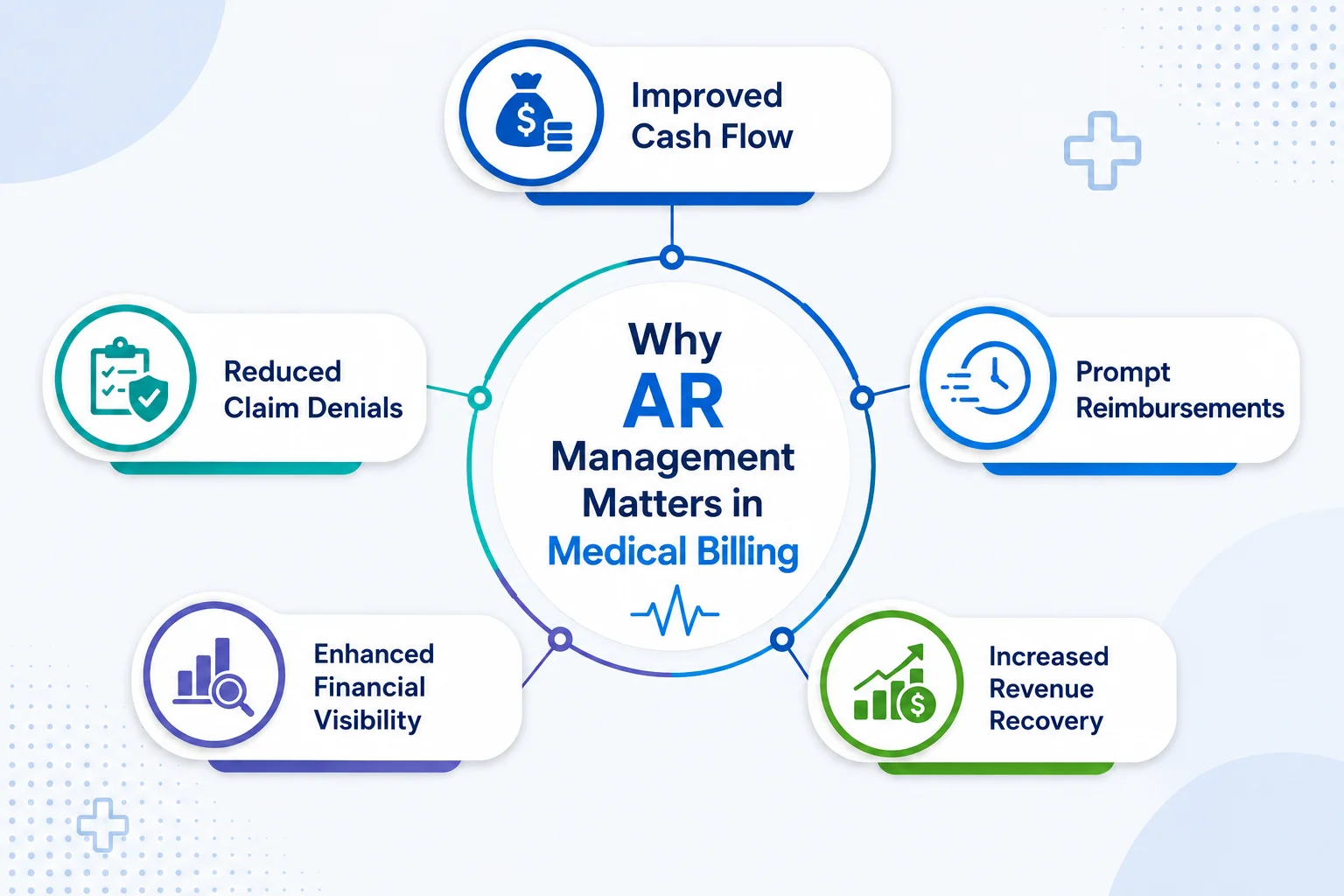
Improved Cash Flow
With timely claim follow-ups, the provider can improve cash flow.
Reduced Claim Denials
Regular claim reviews can ensure that errors are caught early, thus avoiding claim denials.
Prompt Reimbursements
Effective accounts receivable management results in quick payment cycles.
Enhanced Financial Visibility
The healthcare organization will have visibility into outstanding amounts and claim age.
Increased Revenue Recovery
Through regular follow-ups, the providers will be able to recover payments.
AR Management in Medical Billing: Key Components
Successful AR management involves several interconnected processes.
Claim Submission
This starts with proper claim preparation and submission. Claims that are clean tend to be paid on the first attempt.
Payment Posting
Any payments received from insurers or patients are recorded in patient records.
Receivables Tracking
Staff members examine any outstanding claims and look at those that need to be followed up.
Insurance Follow-Up
Any claims that are outstanding after their deadline are examined, and appropriate health insurance companies are notified about the problem.
Patient Follow-Up
Patients’ outstanding payments are followed up on and collected using appropriate communication strategies.
Denials Management
Denied claims are analyzed, rectified if required, and resubmitted for payment.
What is AR Follow-Up in Medical Billing?
“AR Follow-Up” refers to the continuous process of following up on unpaid insurance claims and balances to facilitate their repayment in a timely manner. AR follow-up is an important aspect of the revenue cycle because it helps prevent claims from going into arrears or from being written off entirely.
In AR follow-up, a billing specialist communicates with insurance payers in order to establish the state of processing the claims, the reason why the claims might have been delayed, and how to address those problems. The communication involves addressing any mistakes made during billing or coding, submitting the required appeals, and so forth.
AR Denial Management in Medical Billing
Denials form one of the most critical problems in the AR management process since they cause delays in payments and put an additional burden on billing departments. Denials mean that the payer rejected the claim because there were certain problems that should be addressed to resubmit the claim for processing.
There are several possible reasons why claims may be denied, such as incorrect or missing documentation, errors in the eligibility verifications, improper coding, lack of prior authorization, duplication, and untimely submission of claims.
An efficient AR denial management process should involve the determination of the reason for each denial, error correction, and implementing preventive measures to avoid further mistakes.
AR Challenges in Medical Billing
Managing Accounts Receivable (AR) in medical billing comes with several challenges that can directly impact cash flow and revenue cycle performance.
Insurance Claim Denials
Claims are often denied due to missing information, coding errors, eligibility issues, or lack of medical necessity, leading to delayed reimbursements and increased AR balances.
Bad Debt
Bad debt occurs when patients fail to pay their medical bills due to being uninsured, underinsured, or financially unable to pay, resulting in direct revenue loss for the practice.
Unpaid Patient Responsibility
With rising high-deductible health plans, patients are responsible for a larger share of medical costs, which often leads to delayed or missed payments.
Disorganized Collection Process
A lack of proper follow-up systems, training, or technology can create delays in payment collection and increase outstanding AR balances.
Medical Billing Write-offs
When payments are considered uncollectible, they are written off as losses. Unnecessary or unmanaged write-offs can lead to significant revenue leakage.
Eligibility and Documentation Issues
Incorrect eligibility verification or missing clinical documentation can result in claim rejections and payment delays.
Prior Authorization Problems
Missing or incorrect prior authorizations often lead to denied claims, increasing administrative workload and slowing down reimbursements.
By addressing these challenges with a structured AR management system, healthcare providers can reduce delays, improve collections, and maintain a healthier revenue cycle.
Effective Best Practices for AR Management
There are ways that healthcare organizations can enhance the effectiveness of their AR management processes.
Verify Insurance Eligibility
Insurance eligibility verification prior to service provision will ensure claim accuracy.
Submit Accurate Claims
Proper coding and documentation will help eliminate the possibility of denials.
Target Older Accounts
Older accounts should be prioritized to avoid lost revenue.
Identify Claim Denial Patterns
Recurrent reasons for denials should be established and addressed.
Follow Up Early
Communications will help hasten claims processing.
Use of Analytics
Reports generated from analytics will help improve efficiency.
Takeaway
Management of accounts receivable is an important process in medical billing and revenue cycle management in healthcare organizations. Proper management of AR allows health care providers to manage late payments and recover money while reducing claims denials.
Businesses that invest in efficient AR management are likely to enjoy stability in business operations, efficiency, and the ability to offer uninterrupted services to patients.
Improve Your AR Performance with eClaim Solution
Looking for help with CCM coding and compliance? Check out eClaim Solution; we boost your coding accuracy, cut down denials, and give you more reimbursement chances.
Frequently Asked Questions (FAQs)
In medical billing, AR represents amounts due from health insurers or patients for the services rendered.
The majority of healthcare organizations strive to keep AR days less than 30–40 days, with fewer days being indicative of a more efficient reimbursement process.
Denial management enables the detection, correction, appeals, and prevention of denied claims, thereby increasing revenue generation.
Outsourcing the AR management process allows organizations to generate more revenue and receive reimbursements promptly.
Book a Consultation
Categories
Table of Content
- What is AR in Medical Billing?
- Understanding Accounts Receivable in Healthcare
- AR Aging Report in Medical Billing
- Why AR Management Matters in Medical Billing
- AR Management in Medical Billing: Key Components
- What is AR Follow-Up in Medical Billing?
- AR Denial Management in Medical Billing
- AR Challenges in Medical Billing
- Effective Best Practices for AR Management
- Takeaway
- Improve Your AR Performance with eClaim Solution
- Frequently Asked Questions
Comprehensive Medical Billing Services

REVENUE CYCLE MANAGEMENT
Let Us Handle Your Billing Challenges
From coding to collection, our end-to-end RCM services help you get paid faster and focus on what matters most your patients.