
ICD 10 Codes for Skin Tags: What You Must Know Before Submitting Claims to Insurance
The most critical part of dermatology practice is billing – especially for the tiny procedures such as skin tag removal, which require medical necessity accuracy and clean documentation. And that’s why, before submitting claims to payers, you should know how to bill ICD-10 codes for a skin tag removal because it has two categories: billable and non-billable, based on payer policies.
If you’re one of those who perform skin tag removals and face repetitive denials due to coding errors, then this guide is for you. Here’s what we will cover in this guide:
- Understanding of skin tags: what they are and when you can bill for them.
- Billable Vs. Non-Billable ICD-10 codes for skin tag removal.
- Diagnosis (ICD-10) Vs. Procedural (CPT) Codes for skin tags.
- Best dermatology practices to follow for faster reimbursements.
What is a Skin Tag?
Skin tags are commonly known as the “Acrochordon” in medical terms. These are the small, soft, flesh-colored flap that hangs slightly from the skin.
Further, they appear on different body parts, primarily where friction occurs, such as armpits, neck, and eyelids, and can irritate when rubbed against the skin, cloth, or jewellery. Most skin tags are harmless and never develop into any skin disease (especially cancer), so many dermatologists suggest not removing them unless they cause irritation or bleeding.
When can you claim skin tag removal on insurance?
The healthcare provider bills only for skin tag removal when there is bleeding, irritation, or other medical necessity for the treatment. Otherwise, if the removal is due to a cosmetic concern, the patient needs to pay out of pocket because the payer doesn’t cover the service.
And that’s why ICD-10 codes matter most for skin tag removals: they support medical necessity, clear documentation, and proof of the reason for treating skin tags, ensuring an accurate and fast billing process.
If you want to understand the role of medical coding in billing, check out this guide.
List of Common ICD-10 Skin Tag Codes
To help you understand billable and non-billable ICD-10 codes for skin tag removal, we have created a list that distinguishes them both. It enables you to know when to submit claims for skin tag removal and when not to, so you can avoid denials, improve reimbursement, and maintain a smooth medical billing process.
Billable ICD-10 Codes for Skin Tag Removal
The following are commonly used ICD-10 codes for skin tag removal.

L91.8 for Other Hypertrophic Disorders of the Skin
L91.8 ICD-10 codes for skin tag removal are assigned for the other hypertrophic disorders of the skin — that means there’s no other specific code available to use. When the healthcare professional needs to remove this due to discomfort, bleeding, or other medical concerns, then they should use L91.8 for diagnosis. In addition, billers must ensure that clear, clean medical documentation is provided at the time of claim submission to facilitate faster, more accurate payments.
In such cases, experienced medical coding services help ensure L91.8 is properly supported with documentation, reducing audit risk and improving first-pass claim acceptance.
D23.9 for Benign Neoplasm of Skin, Unspecified
If healthcare professionals identify a skin neoplasm as benign during patient visits, they must use the D23.9 code for diagnosis. D23.9 includes benign hair follicles, sebaceous glands, and sweat glands.
Moreover, when a doctor treats a benign skin neoplasm, such as a skin tag, they must use the appropriate CPT code for reimbursement.
L98.8 for Other Specified Disorders of the Skin and Subcutaneous Tissue
When medical documents don’t support L91.8, use ICD-10 L98.8. Moreover, keep in mind that L98.8 isn’t just for the skin tags; it also refers to other specified disorders of the skin and subcutaneous tissue, so preparing clean medical notes is necessary for the quick and on-time payments.
K64.4 for Residual Hemorrhoidal Skin Tags
If the patient has skin tags that cause hygiene issues or irritation after the hemorrhoids have been treated or absorbed, the healthcare professional can use the ICD-10 code K64.4. Moreover, always make sure the hemorrhoids are not active, because removal isn’t allowed due to patient safety concerns, and k64.4 can’t be used.
Non-Billable ICD-10 Codes for Skin Tag Removal
Let’s look over the non-billable ICD-10 codes for skin tag removal.
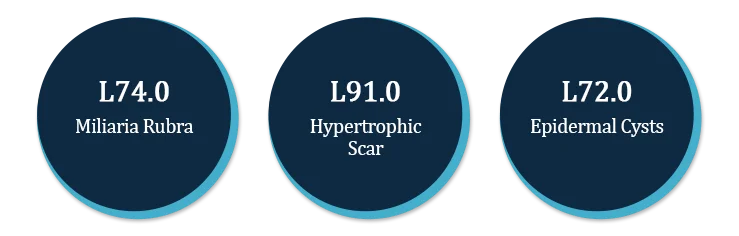
L74.0 for Miliaria Rubra
The most common non-billable ICD-10 code used for the removal of a skin tag is L74.0, due to confusion with skin diseases. L74.0 is used for “Miliaria Rubra”, a condition also known as “prickly heat” or “heat rash”. Just because, in the beginning, Miliaria Rubra often looks like skin tags, billers usually use L74.0, which can lead to claim rejections or even denials.
Therefore, when the patient visits, healthcare professionals must review their previous medical records to determine whether they have skin tags or miliaria rubra, thereby avoiding payment delays.
L91.0 for Hypertrophic Scar
Hypertrophic scars are raised, red, and often bumpy areas that appear within the boundaries during the healing process. It may look similar to skin tags to some doctors and billers, so they mistakenly assign L91.0 codes for skin tag removal.
That’s why you should ensure to use accurate diagnosis codes, because a mismatch with the CPT code can result in delays in reimbursement.
L72.0 – Epidermal Cysts
Epidermal cysts are harmless, slow-growing, yellow or reddish bumps that appear on the surface of the skin on various body parts, such as the neck, trunk, or face. The code L72.0 is assigned for epidermal cysts, but the biller often mistakenly uses it for skin tags, as both conditions appear similar. L72.0 can cause instant claim denials and slow down the reimbursement process.
Skin Tag Diagnosis vs Procedure Coding (ICD-10 vs CPT)
In medical billing for skin tag treatment, assigning medical codes is a complex step that requires accuracy, expertise, and attention to detail to ensure faster reimbursement. Further, if the diagnosis codes differ from the CPT codes for the skin tag treatment, denials occur, increasing administrative burden, resubmissions, and the need to appeal for rightful payment.
Here’s what CPT codes you should assign during the skin tag billing process;
- CPT 11200: Use the 11200 CPT code for the removal of 1-15 skin tags for any area, whether it’s the face, neck, or groin, regardless of the method.
- CPT 11201: When the skin professional removes 15 skin tags and needs to do more, use CPT 11201 for additional ones.
Example:
A patient visits due to irritation and bleeding from a skin tag on the back of the body, and the provider removes approximately 24 skin tags. In this case, the biller must use ICD-10 code L91.8, along with CPT 11200 for the initial 15 skin tag removals, and add on 11201 for the remaining 9 lesions.
If a healthcare professional removes 30 skin tags from any area of the body, they must use CPT 11200 for the first 15 skin tags and two units of CPT 11201 – one unit equals 10, and the other indicates the remaining 5.
ICD-10 Coding Guidelines for Dermatology Practices
Dermatology billing is among the most complex, as it falls into two categories: medically necessary procedures and cosmetic procedures, which are often not covered by health insurance companies. And it is all based on the diagnosis (ICD-10) codes, as it helps payers know whether the treatment/service should be reimbursed or not.
To avoid denials of medically necessary treatments for skin diseases, such as skin tag removal and lesion excision in any body area, you must follow ICD-10 guidelines that support the overall revenue cycle and help ensure timely payments.
Here’s what you do during dermatology billing;
- Always stay up to date on the annual ICD-10 coding changes in dermatology practice.
- Make sure to use accurate and valid CPT codes that match the diagnosis codes.
- During claim submission, ensure clean, clear documentation that accurately supports the treatment or service.
- Further, always use proper modifiers (if required) to avoid losing money.
If you’re reading this guide and looking for reliable medical coding companies in the USA to support accurate ICD-10 compliance and dermatology billing, you may find this detailed resource helpful.
Frequently Asked Questions
For skin tags, ICD-10 codes are diagnostic medical codes that support the medical necessity of the claim and help avoid payment delays or denials. Using valid, up-to-date, and payer-specific ICD-10 codes is mandatory to improve the financial workflow of the medical billing cycle.
The billing code for skin tag removal depends on the procedure performed by the professional to treat the patient. However, there are common CPT codes for skin tag removal are;
- 11200 CPT code – used for up to 15 lesions.
- 11201 CPT code – used for the add-on count above 15, removal of skin tags.
Note: CPT code 11201 can’t be billed alone; it is always used with 11200.
Other names for a skin tag include Acrochordon, Fibroepithelial polyp, Soft fibroma, Cutaneous papilloma, Skin polyp, Fibroma molluscum, and Cutaneous tag.
CPT 11201 is used for multiple skin tags: above 15 tags and below 11. Use CPT 11200 for the initial 15 tag removal, then use 11201 for 10 tags only, and increase units as per the treatment requirement.
Book a Consultation
Categories
Comprehensive Medical Billing Services

REVENUE CYCLE MANAGEMENT
Let Us Handle Your Billing Challenges
From coding to collection, our end-to-end RCM services help you get paid faster and focus on what matters most your patients.